
Introduction
In investing, return alone does not provide a complete picture of performance. Two portfolios may generate the same return, yet one may involve significantly higher risk. This is why finance professionals rely on risk-adjusted return metrics to evaluate how efficiently an investment generates returns relative to the risk taken.
Three of the most widely used measures are the Sharpe Ratio, Sortino Ratio, and Treynor Ratio.
Why Risk-Adjusted Return Matters
| Portfolio | Return | Risk (Std Dev) |
|---|---|---|
| A | 12% | 18% |
| B | 12% | 9% |
Even though both give 12%, Portfolio B is better because it takes less risk.
Step 1: Types of Risk
| Risk Type | Meaning | Used In |
|---|---|---|
| Total Risk | All ups and downs | Sharpe |
| Downside Risk | Only losses | Sortino |
| Market Risk | Beta (market movement) | Treynor |
Step 2: Sharpe Ratio
Definition
Measures excess return per unit of total risk
Sharpe Ratio=σpRp−Rf
Example
Return = 12%, Risk-free = 4%, Std Dev = 10% → Sharpe = 0.80
Full Solved Example (Step-by-Step)
Let’s take a more detailed real-world style example:
| Year | Portfolio Return |
|---|---|
| 1 | 10% |
| 2 | 14% |
| 3 | 6% |
| 4 | 12% |
| 5 | 8% |
Step 1: Calculate Average Return
(10 + 14 + 6 + 12 + 8) / 5 = 10%
Step 2: Risk-free rate = 4%
Step 3: Calculate Standard Deviation (simplified)
Returns fluctuate around 10%, giving approx Std Dev ≈ 3%
Step 4: Apply formula
Sharpe = (10 − 4) / 3 = 2.00
Interpretation
This is a very strong Sharpe Ratio, meaning the portfolio generates high return relative to total volatility.
Step 3: Sortino Ratio
Definition
Measures excess return per unit of downside risk only
Sortino Ratio=σdRp−Rf
Full Solved Example (Step-by-Step)
Using same data:
| Year | Return |
|---|---|
| 1 | 10% |
| 2 | 14% |
| 3 | 6% |
| 4 | 12% |
| 5 | 8% |
Target return = 8%
Step 1: Identify downside returns
Only values below 8% → 6%
Step 2: Calculate downside deviation
Difference from target = (6 − 8) = -2%
Square = 4
Average ≈ 4 → sqrt = 2% downside deviation
Step 3: Apply formula
Sortino = (10 − 4) / 2 = 3.00
Interpretation
Very high Sortino Ratio means minimal downside risk and strong performance.
Step 4: Treynor Ratio
Definition
Measures excess return per unit of market risk (beta)
Treynor Ratio=βpRp−Rf
Full Solved Example (Step-by-Step)
Assume:
| Portfolio | Return | Beta |
|---|---|---|
| X | 10% | 0.8 |
Risk-free = 4%
Step 1: Excess return
10 − 4 = 6%
Step 2: Divide by beta
6 / 0.8 = 7.5
Interpretation
For each unit of market risk, portfolio generates 7.5% return.
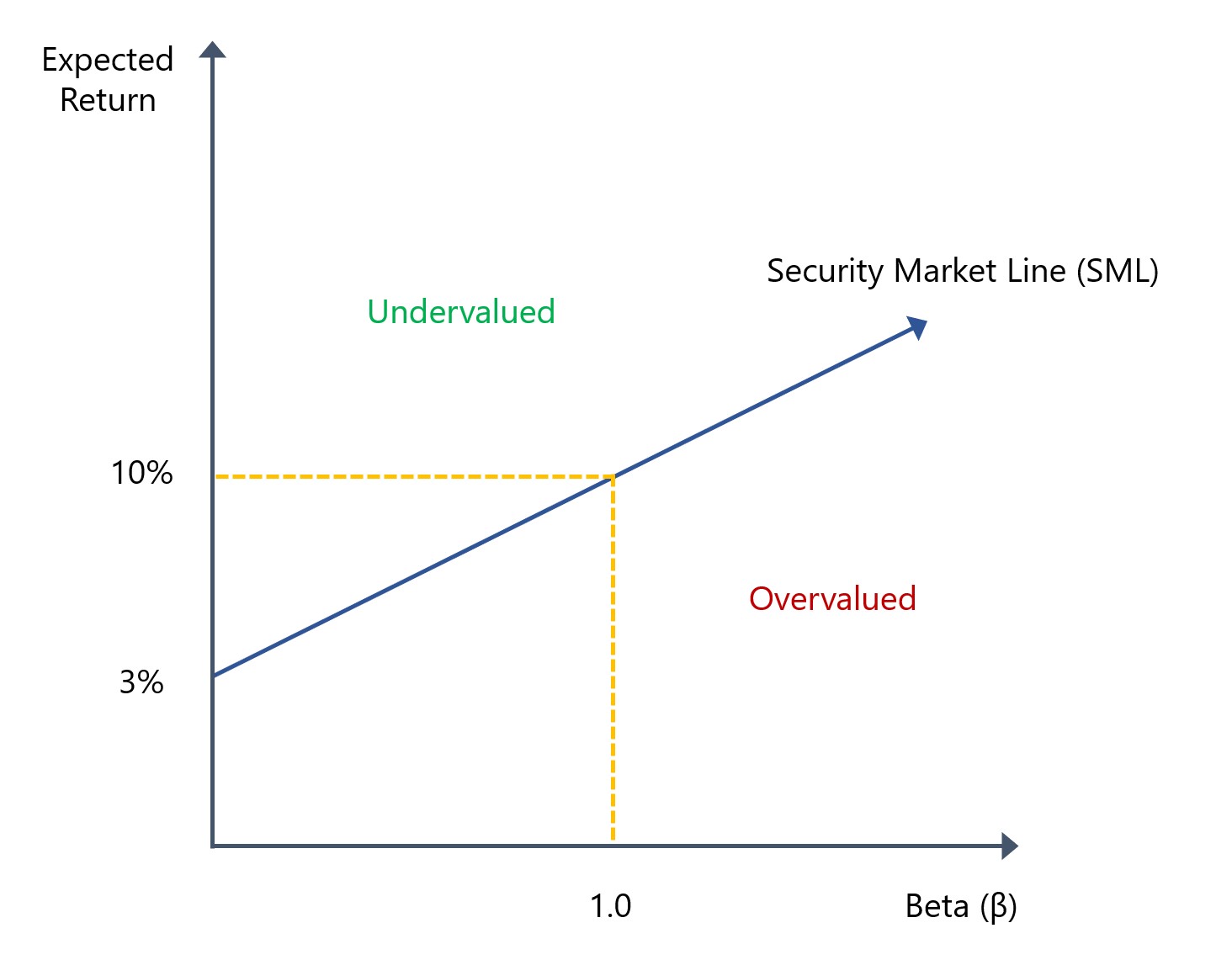
Step 5: Graphs with Real Points and Numbers


Step 6: Detailed Graph Reading with Numbers (Very Easy)
🔹 Graph 1: Sharpe Ratio (Total Risk vs Return)
| Portfolio | Return | Risk |
|---|---|---|
| A | 10% | 5% |
| B | 12% | 10% |
| C | 14% | 20% |
Risk-free = 4%
Sharpe:
- A = (10−4)/5 = 1.20
- B = 0.80
- C = 0.50
👉 Best = Portfolio A
Explanation:
A gives strong return with very low risk → highest efficiency
Visual logic:
Steepest line = best Sharpe
🔹 Graph 2: Sortino Ratio
| Portfolio | Returns |
|---|---|
| A | 10, 9, 11, 10, 9 |
| B | 15, -5, 18, -6, 20 |
| C | 12, 8, 13, 7, 11 |
Target = 8%
Downside:
- A = none
- B = large losses
- C = small losses
👉 Best = Portfolio A
Explanation:
A has almost zero downside → highest Sortino
Visual logic:
Less shaded area = better
🔹 Graph 3: Treynor Ratio
| Portfolio | Return | Beta |
|---|---|---|
| A | 10% | 0.5 |
| B | 12% | 1.0 |
| C | 14% | 2.0 |
Treynor:
- A = 12
- B = 8
- C = 5
👉 Best = Portfolio A
Explanation:
A delivers good return with lowest market exposure
Visual logic:
Steepest slope = best
Step 7: Final Comparison Table
| Portfolio | Sharpe | Sortino | Treynor | Best In |
|---|---|---|---|---|
| A | 1.20 | Highest | 12 | ✅ All |
| B | 0.80 | Lowest | 8 | ❌ Weak |
| C | 0.50 | Medium | 5 | ❌ Risky |
Key Takeaways
- Sharpe Ratio measures return per unit of total risk
- Sortino Ratio measures return per unit of downside risk
- Treynor Ratio measures return per unit of market risk
- Full solved examples show how each ratio is calculated step by step
- Graph 1 (Sharpe) identifies best portfolio using slope vs total risk
- Graph 2 (Sortino) identifies best portfolio using lowest downside area
- Graph 3 (Treynor) identifies best portfolio using return per beta
- Portfolio A performs best across all ratios due to efficient risk management
- High returns alone do not guarantee better performance if risk is excessive
- Combining all three ratios gives a complete and professional evaluation of investments